














No items in cart
Currently you don't have any items added to your cart. Select some items then come back here to complete your purchase.
Go to shop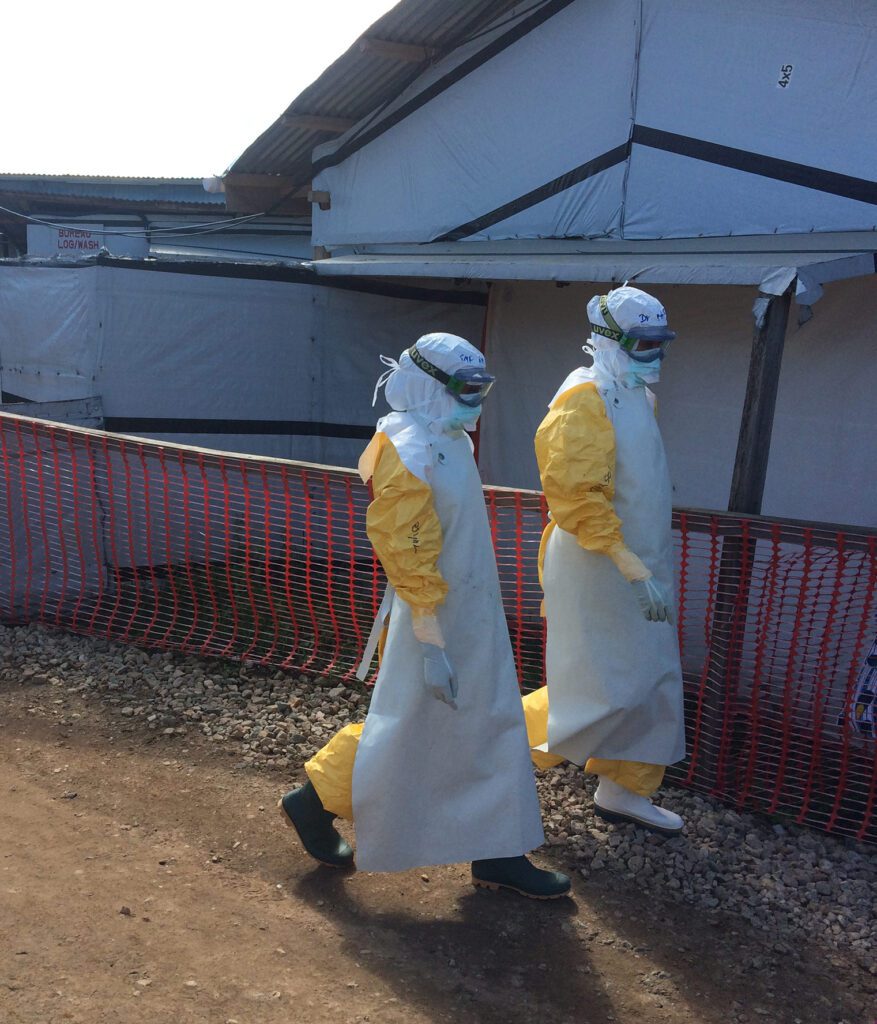
This is the 17th time that Ebola has struck the DRC (credit: Nick Frey)
To date, at least 220 people have succumbed to the Ebola virus and some 1,000 suspected cases have been reported (source: BBC). Most of the cases are located in Ituri Province – the northeastern corner of the DRC, which borders Uganda and South Sudan.
The World Health Organisation has called this crisis ‘a public health emergency of international concern’.
Although the DRC’s Ministry of Transport decreed on Saturday 23 May that aircraft were prohibited from landing and departing from Bunia – Ituri’s capital city where MAF has a base – MAF has been granted special permission to fly between the DRC and Uganda on a case-by-case basis.
On Tuesday 26 May, MAF received additional permissions to operate at several other local airstrips for one month as part of the charity’s disaster response. As a result, MAF has been conducting a number of critical flights in a bid to help contain the disease.
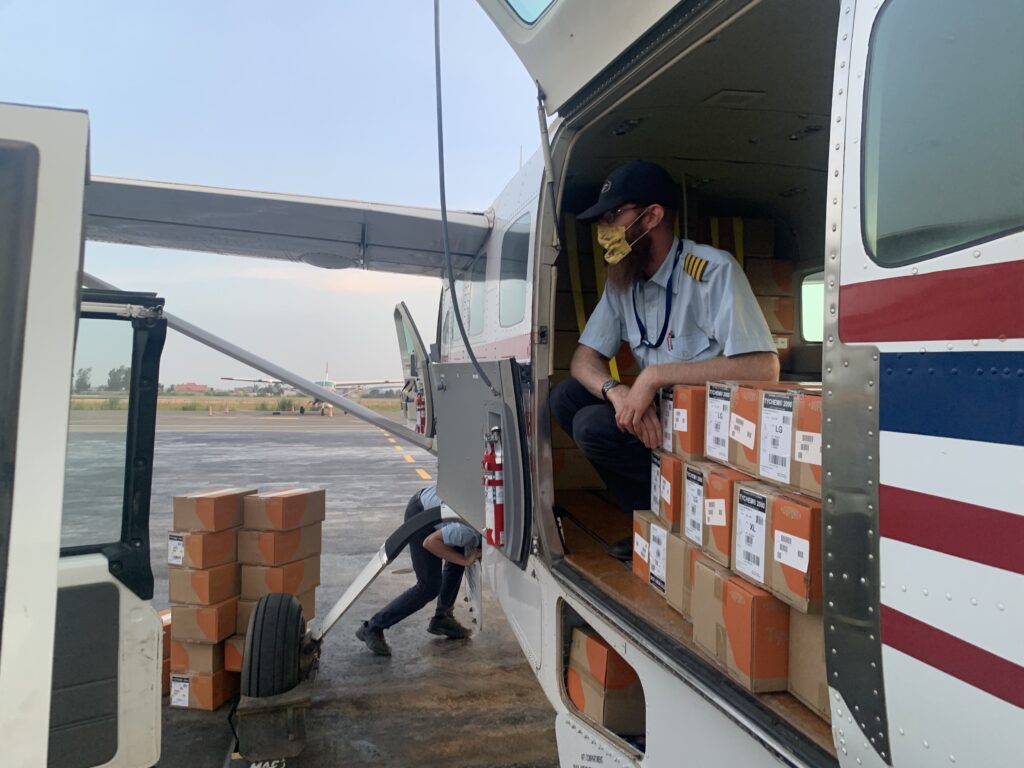
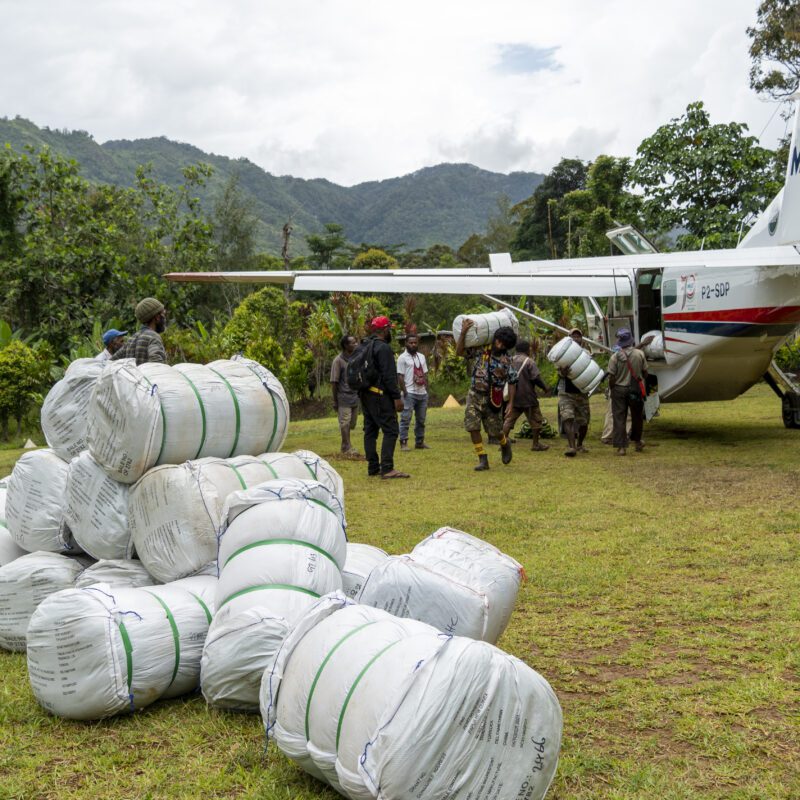
MAF flies dozens of boxes of hazmat suits to Bunia (credit: MAF US)
MAF’s latest flight on Tuesday 26 May delivered a plane load of hazmat suits from Entebbe in Uganda to Bunia – vital for reducing the risk of infection whilst caring for the sick and handling the deceased.
Earlier that same day, MAF flew the Ebola Crisis Manager from the ‘Africa Centre for Disease Control and Prevention’, and a team from Samaritan’s Purse to respond to the outbreak.
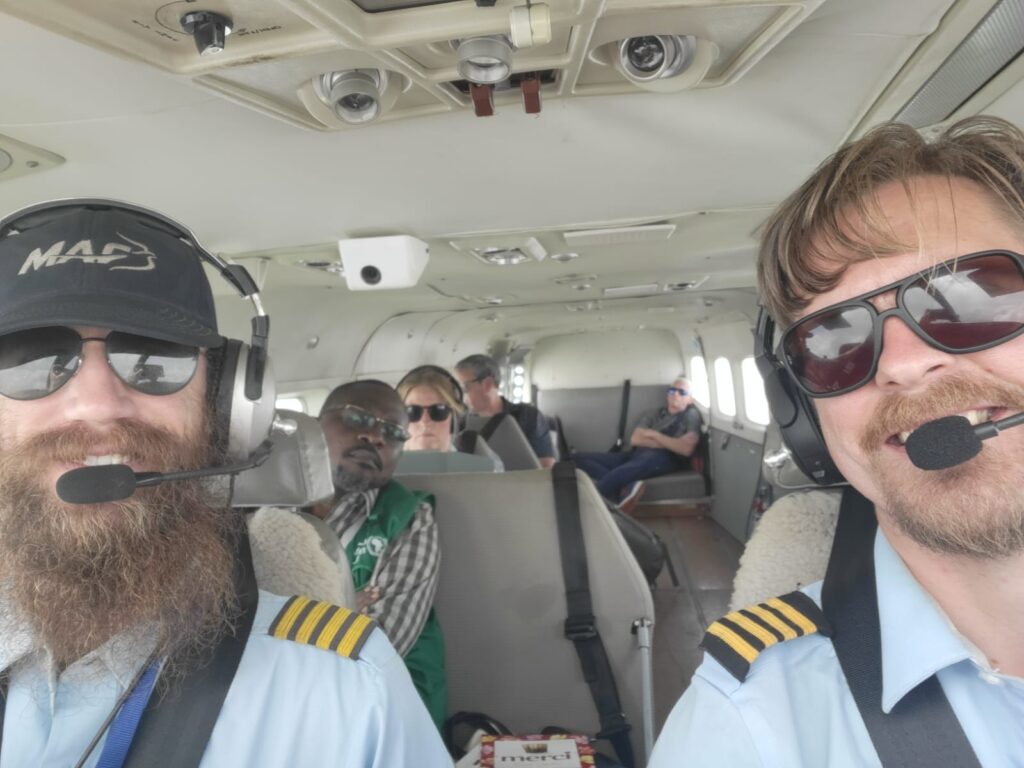
MAF Pilot Alfred Ottosson (R) flies a crisis team from Uganda (credit: MAF US)
MAF Pilot Alfred Ottosson is on the front line:
‘Although the number of deaths and Ebola cases are still rising, we can celebrate this forward step in the crisis response.
‘A big shout-out to all those involved in arranging the flights, permissions, and scheduling. It is also amazing to see the collaborative effort between organisations, as well as from the authorities to work through constantly changing circumstances.
‘We praise God for opening up ways to serve the Congolese people to bring them help, hope and healing.’
Alfred Ottosson, MAF Pilot in the Democratic Republic of Congo
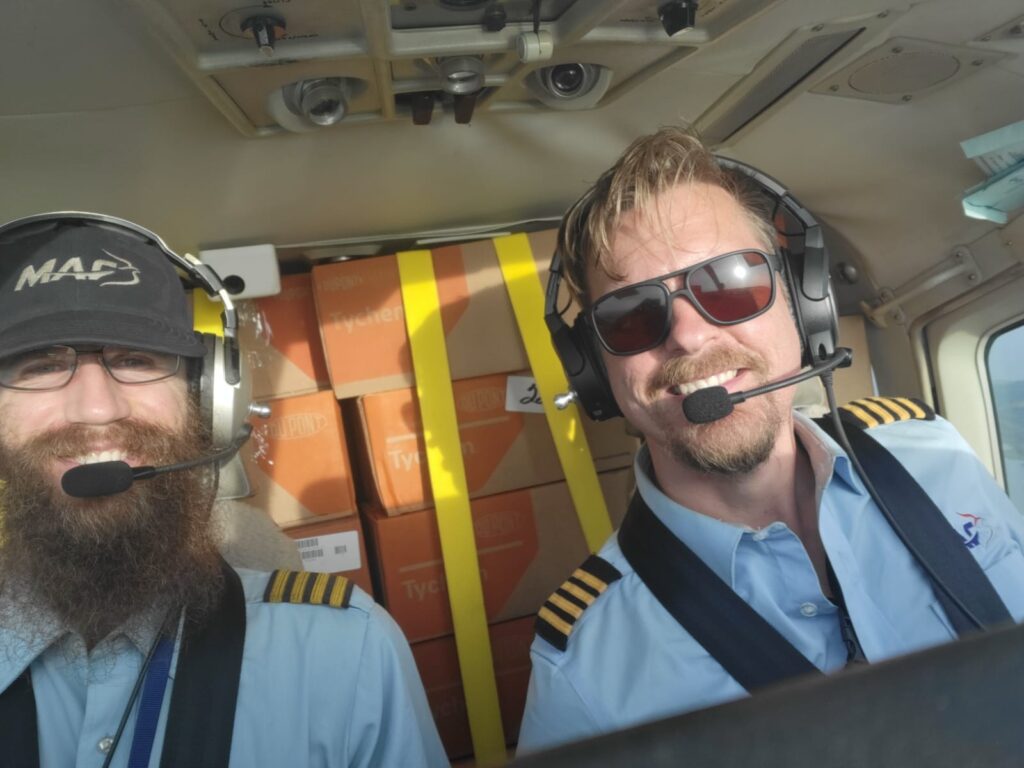
MAF’s Alfred Ottosson (R): ‘It’s amazing to see the collaborative effort’ (credit:MAF US)
Prior to this, MAF flew a major medical organisation several times to Ituri from the DRC’s capital, Kinshasa.
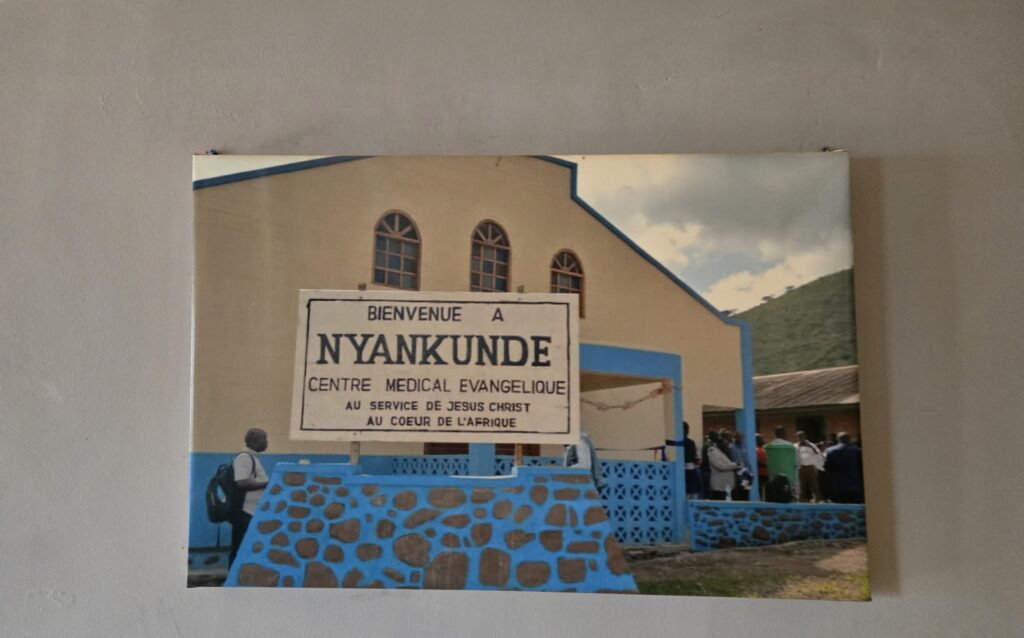
The doctors caught Ebola at Nyankunde Hospital – a MAF partner (credit: Brad Hoaglun)
MAF evacuated the family of Dr Peter Stafford who caught Ebola whilst treating patients at Nyankunde Hospital in Bunia – a MAF partner. He tested positive on Sunday 24 May.
Although Peter’s wife Rebekah, also a doctor, had been exposed to the disease, she is asymptomatic – showing no signs of the disease. MAF flew Peter’s wife and children from Bunia Airport to Entebbe in Uganda for safety.
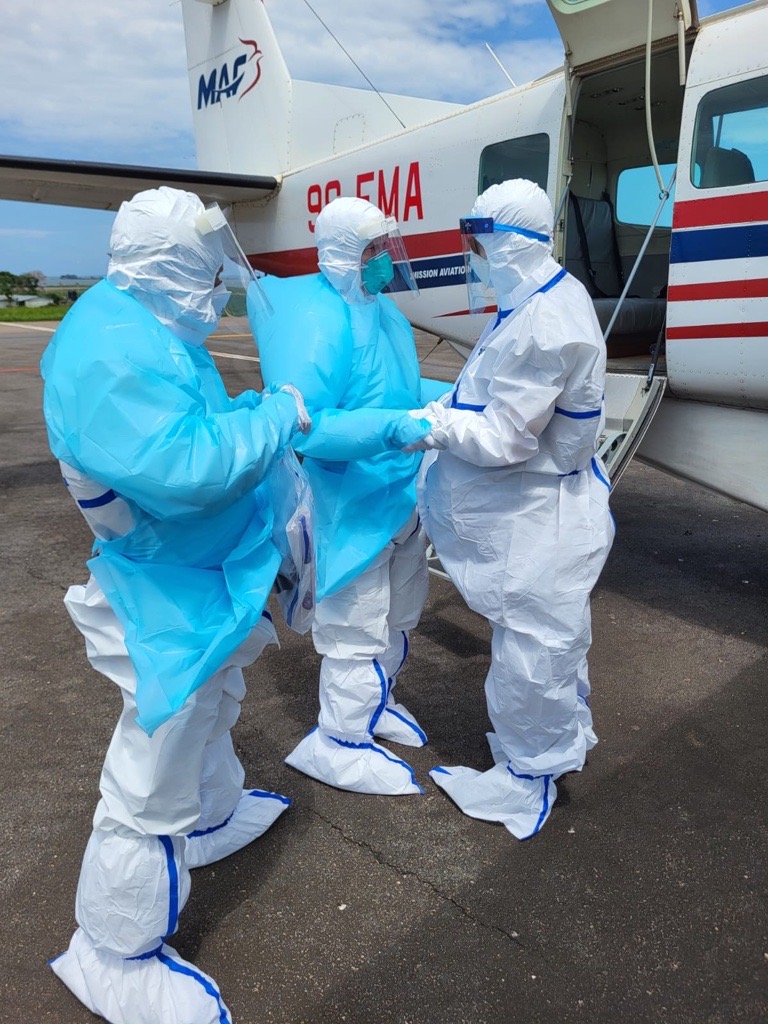
Dr Rebekah Stafford (R) about to board MAF’s plane to Uganda (credit: MAF US)
Peter was medevacked separately to Berlin in Germany for specialist treatment. He is reportedly improving.
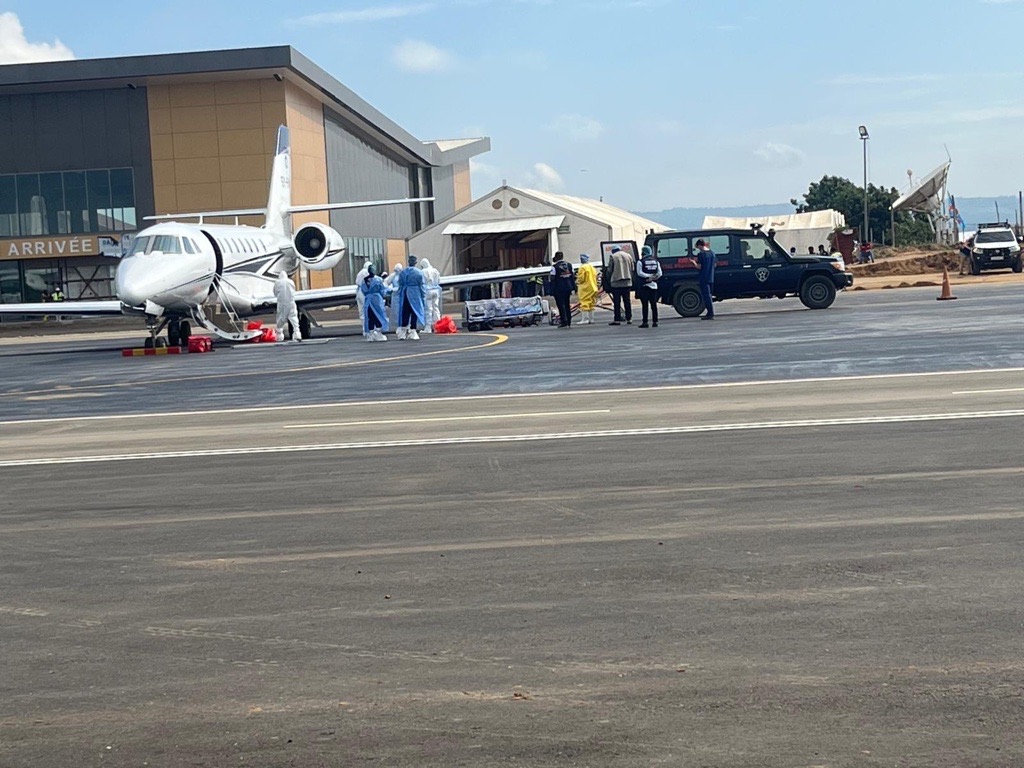
Dr Peter Stafford is medevacked to Germany for special treatment (credit: MAF US)
On the same MAF flight to Entebbe was Peter’s colleague, Dr Patrick LaRochelle. Although Patrick was also exposed to Ebola at Nyankunde Hospital where he works, Patrick and his family are asymptomatic.
As a precaution, Patrick then flew to a hospital in Prague in the Czech Republic where he isolated in a BioBox chamber for at least 72 hours. He remains asymptomatic. Here is an excerpt from his latest statement:
‘It is hard to be separated from my family, friends, and colleagues in Congo. I’m thankful to the Czech people for allowing me to come and be monitored here, and to the many people who worked night and day to get me and the Staffords to care. I want to thank God that my teammate Peter Stafford is recovering from Ebola—and that his wife, children, and I have remained free of the infection. I had a glimpse of the reality that my Congolese friends and colleagues are living constantly, and for which a medical evacuation is not an option.
‘I have seen the commitment of the Congolese doctors leading the response. And I’ve seen the context in which they are working: an outbreak already out of control by the time it was recognised, a region in a constant state of conflict, a province 1,000 miles away from the capital, and an under-resourced health system. The challenges are overwhelming…’
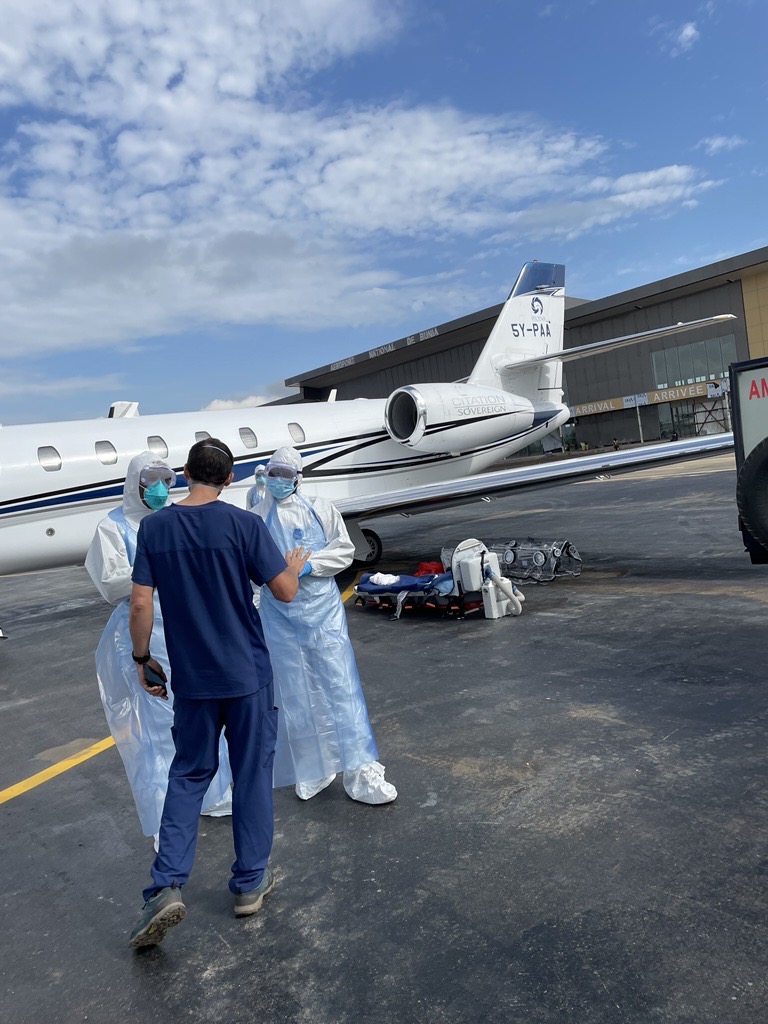
Dr LaRochelle (dark blue) about to board a flight to Prague for treatment (credit: MAF US)
Prior to the Staffords and the LaRochelles, MAF evacuated another missionary family to safety.
All MAF evacuations are coordinated with the DRC’s public health officials and government authorities. As a safety precaution for passengers and crew, strict measures include passenger temperature checks before boarding, mandatory use of personal protective equipment, and thorough aircraft cleaning.
If anyone is found to have a high temperature – one of the symptoms of Ebola – they are not permitted to board a MAF plane.
The flight from Bunia to Entebbe only takes one hour and 10 minutes by air, saving many hours of exhausting road travel for the families.
According to MAF’s Crisis Management Team, every effort is being made to protect staff, but tensions are running high throughout the region:
‘All MAF staff remain in good health, though they are limiting their movement to essential activities only.
‘In addition to concerns around public health, there is a heightened sense of tension in Bunia and the surrounding region as the outbreak continues to spread.
‘National staff have been authorised to remain at home if they desire, and the Crisis Management Team is actively working with country leadership on contingency planning.
‘There are significant challenges on the ground, including delays in establishing treatment centres, the spread of misinformation and conspiracy theories, and increasing suspicion surrounding deaths.
‘We ask that you continue to pray for those in Ituri Province who are affected by this outbreak.’
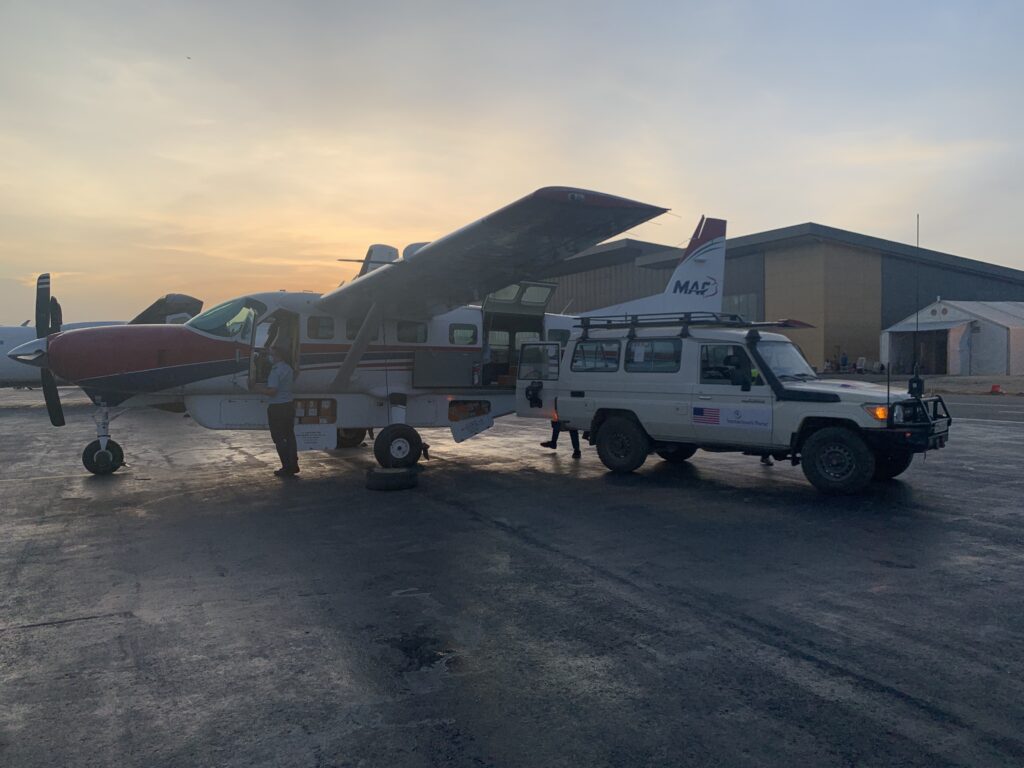
MAF remains on standby for future Ebola flights (credit: MAF US)
This latest outbreak in the DRC features the Bundibugyo strain of Ebola.
Unlike the more common Zaire strain, there is currently no approved vaccine or specific treatment available for this variant.
According to NBC News, there have only been two previous Bundibugyo outbreaks— one in Uganda in 2007 and one in Congo in 2012.
Risk of exposure is low if protocols are followed.
An ‘Ebola Pathogen Management Plan’ is being implemented by MAF in neighbouring Uganda and South Sudan.

Please donate or continue to discover even more stories of how and where we are transforming lives around the world here.
Mission Aviation Fellowship (MAF) is the world’s largest humanitarian air operator. For over 80 years we have been flying light aircraft over jungles, mountains, swamps and deserts. We enable more than 1,500 aid, development and mission organisations to bring medical care, emergency relief and long-term development. Our pilots and personnel deliver relief workers, doctors, pastors, school books, food, medicines - everything that can only be safely and speedily delivered by air. Our faithful supporters give and pray to make this all possible.
© 2026 / MAF UK is a registered charity in England and Wales (1064598) and Scotland (SC039107)
